Political Correctness, Free Speech & The Right To Draw
Consider this scenario: An editorial cartoonist draws a cartoon. The paper she works
for publishes that cartoon. Many readers are upset by the cartoon. They find it highly offensive. They loudly express their outrage and demand that the paper apologize. Not only does the paper apologize, it fires the cartoonist.
The paper was The Daily Texan, the student newspaper of the University of Texas
at Austin. The cartoonist was a student named Stephanie Eisner. Here’s my own reaction to what happened:
As you can tell, my sympathies are with Ms. Eisner. I believe the paper was wrong to censor her work, and wrong to fire her.
Here’s the cartoon that Ms. Eisner drew. You’ll need some background information (below) so you can put her cartoon in context.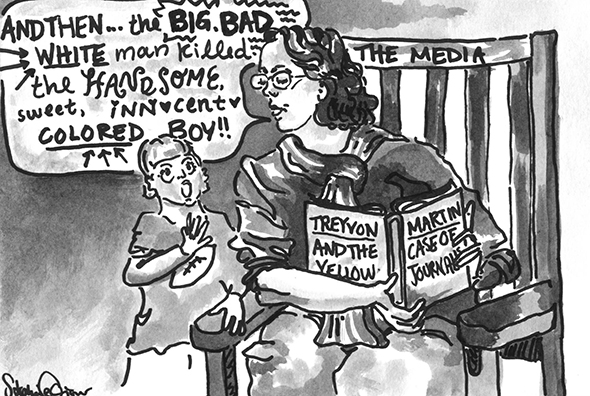
On February 26, 2012, there was a shooting in Sanford, Florida, USA. It took place in a private gated community of 263 townhouses. It’s an integrated community with white, black, and Hispanic residents. Trayvon Martin, a black teenager (17 years old) was shot and killed by George Zimmerman, a 28-year-old neighborhood watch coordinator. Zimmerman is part-white, part-Hispanic. Martin was unarmed, and, on a ludicrous note, was carrying only a can of iced tea and a bag of Skittles candy.
Both men had a right to be in the gated community: Zimmerman lives there. Martin was staying at the home of his father’s fiancée, who also lives in the community. Zimmerman told police he followed Martin because he thought Martin was acting suspiciously. He also told police that Martin attacked him, and that he shot Martin in self-defense.
Self-defense laws in the United States vary by state. Florida law includes a stand-your-ground provision, which says a person is not obliged to retreat before using deadly force if he believes he is in grave danger. In Florida, a person may use such deadly force in a public place, i.e., outside his own home.
Zimmerman was taken into police custody, but eventually released. No charges have been filed against him. The shooting is still under investigation by both federal and state law enforcement agencies.
The case has been covered extensively by the media. Public opinion in the United States is divided along racial and political lines. Blacks and political liberals see the shooting as racially motivated: they believe Zimmerman shot Martin because he was black, and that Zimmerman should be charged with a crime. Whites and conservatives are much less apt to take this view.
Nationally syndicated cartoonists were quick to weigh in on the shooting. Most of them took a liberal slant and implied that Martin, the black teenager, was completely innocent, and that Zimmerman was a racist who shot Martin because he was black. The cartoon below equates Zimmerman with the Klu Klux Klan, which was notorious for lynching southern blacks in the aftermath of the American Civil War (1861-65).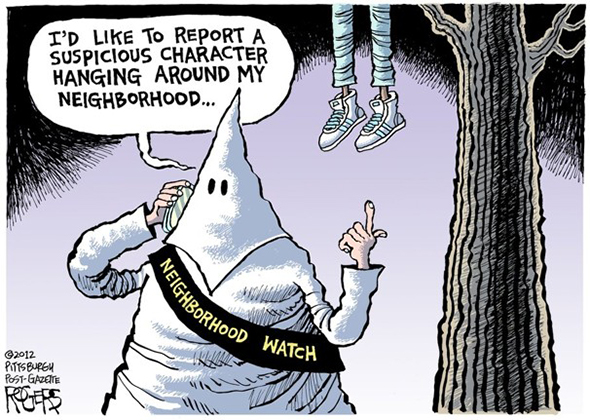
This next one cleverly alludes to Harper Lee’s famous novel, To Kill A Mockingbird, in which the mockingbird symbolizes goodness and innocence: “Mockingbirds don’t do one thing but make music for us to enjoy . . . but sing their hearts out for us. That’s why it’s a sin to kill a mockingbird.”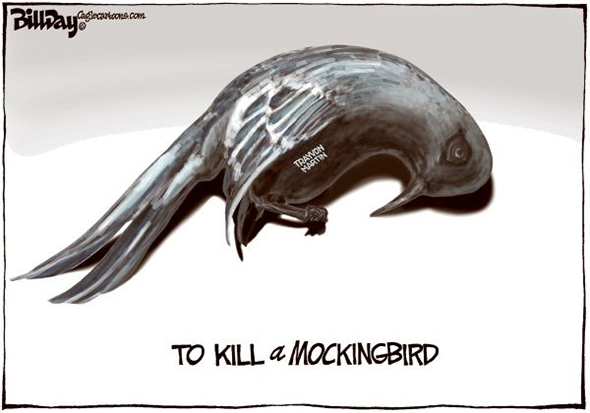
The following cartoon exploits the fact that Martin was carrying a bag of candy. It implies there are whites who would shoot a black child under the pretense of feeling threatened by a lollipop (sometimes referred to as a “sucker”). The cartoon also implies that Martin (the victim) was a small child, and that Zimmerman (the shooter) was a much larger adult. In truth, Martin was 6’1″ tall, about 150 lbs. Zimmerman is 5’9″, about 190 lbs.
The cartoon below uses even more extreme imagery: it’s a Photoshopped film still showing President John F. Kennedy in an open car moments before he was assassinated in Dallas, Texas, on November 22, 1963. Trayvon Martin was wearing a “hoodie” (a hooded sweatshirt) when he was shot. The cartoon suggests the Martin shooting was an assassination, and that Zimmerman shot Martin simply because he was wearing a hoodie.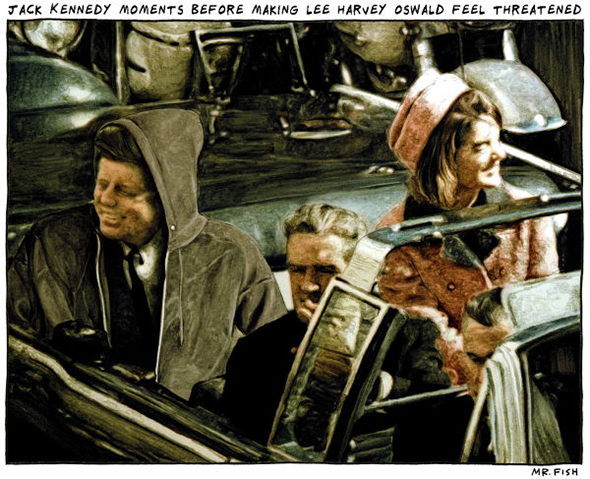
Cartoons which resisted this rush to judgement were much harder to find. One such cartoon (below) summed up the tone of all the preceding cartoons: Zimmerman must be presumed guilty until he is actually found guilty– a clever reversal of a key principal of American law: one must be considered innocent until proven guilty.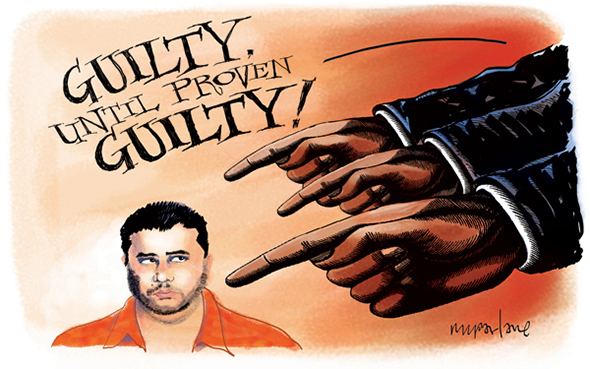
It seems clear to me that Stephanie Eisner was pointing out this rush to judgement in her own cartoon: the black victim is presumed innocent, the white man (actually part-white, part-Hispanic, and self-described as Hispanic on his voter registration) who shot the black victim is presumed guilty. She accuses the media of yellow journalism (reporting that is characterized by exaggeration, scandal-mongering, sensationalism, and sympathy for the underdog against the system). I agree with her on that point.
But she also made a spelling error (she misspelled Trayvon Martin’s first name), and
I think she showed poor judgement in using the word “colored” to describe Martin, as opposed to “black” or “African-American.” It’s possible she chose the word “colored” to
be deliberately provocative, to mock the charges of racism in much of the reporting. But it’s still a mistake, because for some, it’s a derogatory term that harkens back to the days
of racial segregation in the United States, when there were often separate public facilities for whites and “coloreds.” As such, it’s a distracting influence in her cartoon. It takes attention away from her main point: media bias.
Here’s her cartoon again, with problematic text highlighted: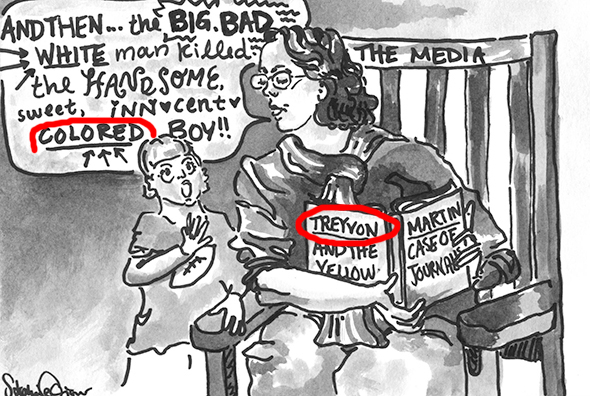
All the cartoons shown in this post, including my own, share a common trait: they are one-sided. They make no attempt to include contrary opinions or different perspectives. They are not above using shock tactics. Little wonder they are often found offensive and
in poor taste. That is the nature of the editorial cartoon.
College campuses are bastions of political correctness (an unwillingness to offend certain groups of people). A reluctance to offend is the enemy of truth and free expression. Stephanie Eisner dared to express an unpopular opinion. I applaud her for it– that’s an editorial cartoonist’s job. I think she showed poor judgement in using the word colored– but did she deserve to be fired because of it? No. Because there’s a larger issue: censorship. A newspaper that censors its own cartoonist is denying its mission. The pursuit of truth requires a free press.
Kevin Benz, editor in chief of CultureMap Austin, wrote an excellent article on the Stephanie Eisner Cartoon Controversy. Here are his concluding remarks. They sum up my own feelings very well:

The calls for censure are an attack on free speech, no different than those of tyrants and dictators who shut down the Internet when things don’t please them. And it’s our job as journalists and citizens, to defend Eisner’s right to draw and The Daily Texan’s right to publish, even when it may be disagreeable, even offensive.
There is simply no way to present cogent media criticism or present unpopular perspectives in a traditional news story, which is exactly why we need editorial commentary, opinion, letters to the editor and editorial cartooning.
Yes, we may choose to disagree with the opinion, we may even be offended, but the point is, good editorial opinion makes us react and think, and that is never a bad thing.
Occasionally we should be reminded of Voltaire’s poignant message: “I may not agree with what you say, but I will defend to the death your right to say it.”
Finally, here’s my own take on the matter again, along with a photo insert showing what Ms. Eisner looks like.
What do you think? Do the benefits of editorial cartooning (e.g., free expression, they make you think) outweigh the negatives (e.g., questionable taste, disagreeable images)? Do you think one’s political ideology tends to color one’s judgement? Hope you’ll leave a comment.
If you enjoyed this post, I invite you to subscribe. You can either leave a comment and click the box that says Notify me of new posts via email, or click on the Subscribe button below the Portfolio Thumbnails in the sidebar at the top right of this page.
Other Posts You Might Enjoy:
A Selection Of My Editorial Cartoons Spanning 2007-2010
Paula Deen, Twinkies, And The National Debt
Ben Franklin Flies Kite, Discovers The Political Cartoon!!
Follow @mrstrongarm


